
A love affair with Mencía wines
By Steven Olson (02-11-2009)
Wine from Spain
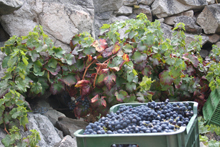
I laid my love of life on the line for my beloved wines from Jerez, and even proclaimed to the world that Albariño, Verdejo, and especially Godello, are now to be recognized next to the world's best white wines. I used the value card to get them to listen, but the proof has always been in the glass, and I have since proudly watched as Spanish wine has assumed its rightful place on the world stage. I am known by many as a fanatic of such relatively obscure D.O.s as Toro and Jumilla, and I stashed away my favorite bottles of Priorato when the world was trying to figure out what those eccentrics were up to. As much as I love all of these brilliant wines, from many amazing regions, today I reveal my true Spanish wine soul: I cannot get enough of the black grape Mencía, and the red wines of that remote area of western Castilla y León and Galicia.
Bierzo is indeed the heart and soul of the Mencía-producing regions, but stopping there would not do justice to the versatility of this very unique grape. Delicious wines fashioned from Mencía are being produced in the D.O.s Ribeira Sacra, Monterrei, Ribeiro, Valdeorras, and yes, even Rías Baixas (even though a miniscule amount of red wine is produced within the D.O.).
When I visited in 1993, I did not taste a single red wine worth writing about or sharing. When I finally returned on a pilgrimage to this magnificent area in 2006, I was inundated with brilliant red wines, from every corner of Galicia, and of course from Bierzo itself.
For many years, red wines from Bierzo, and all of Galicia, were considered light and fruity, simple wines, and thus Mencía was designated a simple grape, capable of producing only this type of wine. This was perhaps a result of phylloxera, when the vineyards were replanted in the valley floors and produced at great volumes and high yields, of course yielding a lighter style of wine. But on the very steep, slate and schist covered hillsides of this Atlantic maritime area, situated above the Río Sil and its tributaries at elevations often over 2300 feet and sometimes up to 2800 feet above sea level.
The best Mencía wines are extremely supple, and show great restraint, enhancing the minerality, and exhibiting finesse and elegance. With a judicious oak treatment, they become ultimate wines of place, an embodiment of the terroir. Is there still the danger of over-extraction, over-oaking, over-the-top alcohol... of creating an international style of wine? Of course that danger is always there, yet even with big ripe fruit, these wines truly dictate a more restrained course of winemaking, or, shall we say, less human influence. Mencía grown in the greatest vineyard sites of Bierzo is one perfect example of great wine being made in the vineyard, and great vineyard sites making truly great wine.
Although the D.O. Bierzo is finally getting the recognition it deserves, Mencía actually is the red wine grape of choice of most of Galicia, in Northwestern Spain, as well, and it surely has turned heads in recent years as quality red wine production in this area has blossomed. D.O. Bierzo had only 20 wineries in 2000, but today there are over 50. As we venture west from Castilla y León and cross the eastern border of Galicia, we follow the Río Sil into the D.O. Valdeorras, a region becoming increasingly well-known for its white Godello wines. (Álvaro's younger brother Rafael is doing ground-breaking work here with his As Sortes project.) Yet the red wines should really get more attention than they do. I have only tasted a few of note, but the varietally-labeled Mencía wine of Casal Novo from Adega O Casal (in Galicia, an adega is a bodega, or winery), has to be one of the best red wine values of this year, delicious in a fresh, very drinkable style that still exhibits all of the lovely varietal characteristics that I have now begun to crave. And by the way, while we are in Valdeorras, Casal Novo's Godello is mind-blowing too.
In D.O. Ribeira Sacra, Mencía, among other grapes, is planted on 2000-year-old Roman terraces ascending the steepest slopes, in one of the most remote wine regions in the world, and great things are happening. Since there is now even a paved road coming out of there, we may actually, finally, be able to taste some of these amazing wines on our shores. Seek out a bottle of the 250 cases of Dominio de Bibei Lacima, crafted by Sara Pérez and her life and business partner (and father of her children), René Barbier, Jr, both of D.O.Ca. Priorato fame (Clos Martinet and Clos Mogador, respectively). The steep vineyards and difficult growing conditions of Ribeira Sacra are similar to those of Priorato. If that is too steep for you, check out the Peza do Rei Mencía, which is still a steal, or the newly released Finca Míllara.
Unfortunately, Mencía is often mistakenly blended with other grapes, particularly Garnacha Tintorera, Garnacha Tinta (Alicante), Tempranillo, Cabernet Sauvignon, Merlot, and María Ardoña (a black grape local to Valdeorras). I believe that Mencía can lose its appeal, its freshness, all of the lovely fruit and floral tones that make it special, when blended with these other grapes, especially with Merlot, which instead of softening the wine, makes it less balanced and too flat, or with Cabernet Sauvignon, added of course for structure, which only hardens Mencía and makes the resulting wines too firm and tannic. Of course, that is only my opinion, and the Garnacha blends have existed much longer than I, so perhaps I am just a purist who adores his pure Mencía!
I will of course continue to enjoy a fine bottle from Montsant or Priorato, a taste of Toro or Ribera del Duero, a gulp here and there of just about any D.O. of Spain, and a sip or two of Sherry before and after my meal. As I continue to watch and admire the renaissance of winemaking, excuse me, winegrowing, throughout Spain, I am most impressed by the sensibility of the wines. I learned long ago that wine belongs on the table, with food, and the wines from Spain seem to have a built-in affinity for food, a natural synchronicity, to taste good with food. If this is something you have yet to experience, or like me, you just cannot get enough good food and wine, then my suggestion is that you slide on into your kitchen with a bottle of Mencía and witness as it unfolds layer upon layer of intoxicating complexity...until it has overtaken your senses with complete delight. Then? Cook whatever you are inspired to eat. I promise, whatever you choose, the match, the pairing, the combination of the wine and the food, will not disappoint.
This grape, Mencía, grown in these conditions, in these places, and tended lovingly by these people, yearns to be consumed with food, and as such, may be the most versatile wine in your cellar, or on your wine list.
Buen provecho!
THE MYSTERY OF MENCÍA
So what, pray tell, is this magical grape, Mencía? Is it Cabernet Franc, as many would have you believe? No, for DNA fingerprinting has definitely proven that it is not Cabernet Franc, although some would argue that they have certain similarities. In fact, Mencía may even be the progenitor of Cabernet Franc (the same grape in Portugal is called Jaen), and it has probably been planted in this area since the Romans were encamped here centuries ago.To me, what is important is not from whence Mencía came, but what it has become, or rather what it can be in the right hands. When working with old vines, grown in slate/schist soils, on very steep slopes, at high altitudes, harvested at low yields, in a relatively cool climate, Mencía is capable of producing deep, dark, beautiful wines with good acidity, exotic wildflower floral tones, red, black and blue fruits, and soft, round tannins. In these conditions, in this type of climate, this grape can reach amazing complexity at lower alcohol levels, while still reaching complete phenolic ripeness, which yields sweet, ripe tannins, and yet has a perfect balance of acidity at moderate alcohol (imagine its versatility for food, and the potential to age!)
